· 01 CATEGORY
Conductive inks for printed electronics
Silver, carbon and hybrid conductive inks for printed electronics, developed for screen printing flexible electronic circuits, sensors, RFID antennas and membrane switches. VFP formulations address conductivity, adhesion, flexibility and compatibility requirements across a range of substrates.
01
<10mΩ
Silver /sq
02
PET/PI
Substrates
03
150°C
Curing
· 02
Typical applications
Use cases
- 01
Printed electronics & RFID
Silver and silver-carbon hybrid inks for HF/UHF RFID antennas, flexible circuits on PET and PI. Typical resistivity < 10 mΩ/sq.
- 02
Resistive sensors & membrane switches
Carbon and dielectric inks for membrane keypads, pressure and humidity sensors, industrial touch interfaces.
- 03
Connected medical devices
Biocompatibility and low migration levels for cardiac monitoring electrodes, detection patches and disposable diagnostics.
· 03
Technical specifications
Key parameters
StandardValue
Silver resistivity
< 10 mΩ/sq at 25 µm
Carbon resistivity
10 – 80 Ω/sq depending on dilution
Curing
80 – 150°C / 15 – 30 min (oven)
Substrates
PET, polyimide (PI), PC, paper
Printing technique
Screen printing 40 – 120 threads/cm
Compliance
REACH, RoHS 3
· 04
Ranges
Category products13 REF.
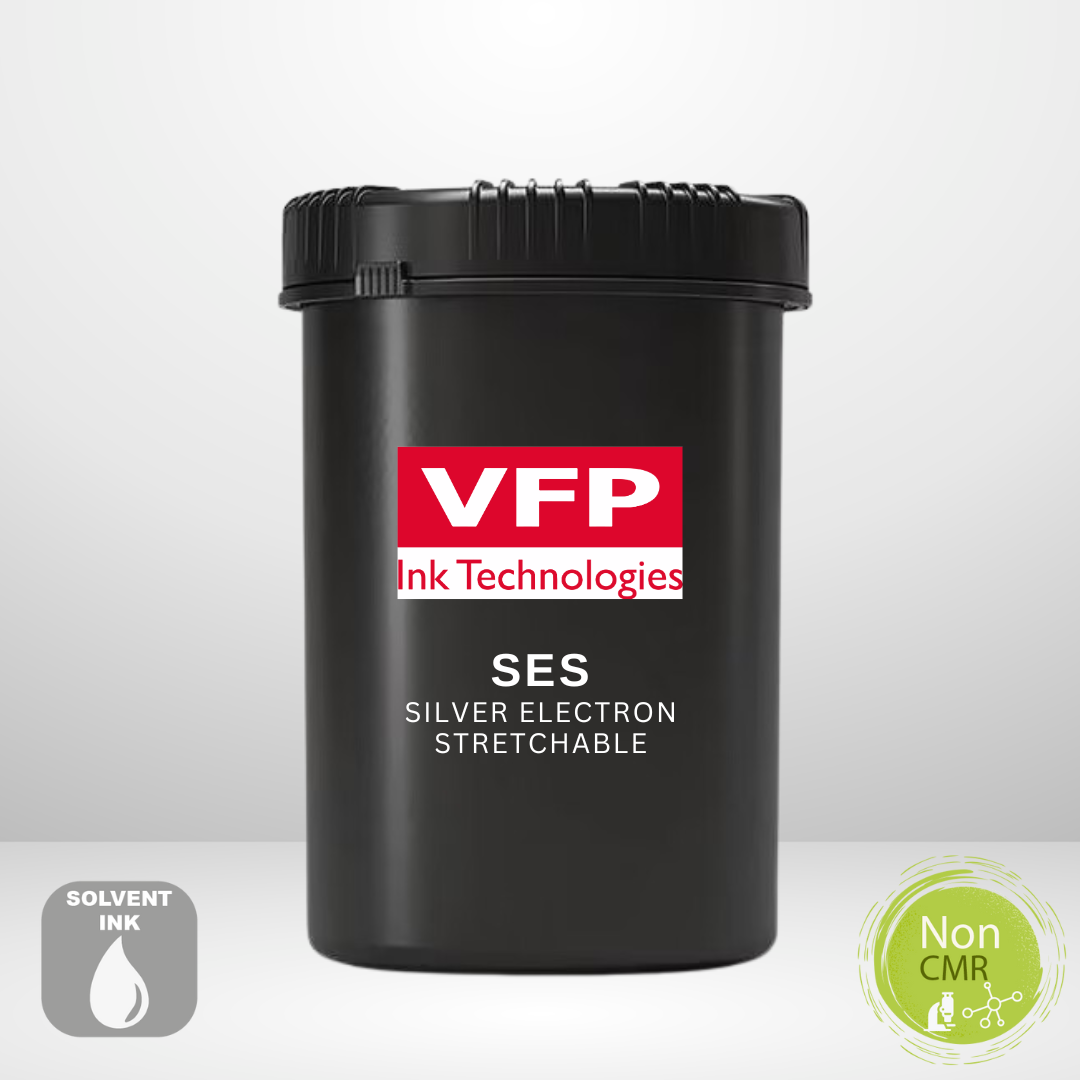
SILVER ELECTRON STRETCHABLE
Stretchable silver conductive ink for printed electronics
Non-CMRSolventConductive ink
FLEXOGRAPHY SILVER ELECTRON
Silver conductive ink for printed electronics
Non-CMRSolventConductive ink
SILVER ELECTRON LOW ENERGY CURING
Silver conductive ink for printed electronics
Non-CMRSolventConductive ink
Low Viscosity - SILVER ELECTRON LOW ENERGY CURING
Silver conductive ink for printed electronics
Non-CMRSolventConductive ink
SILVER ELECTRON CHEMICALLY AND THERMALLY RESISTANT
Silver conductive ink for printed electronics
Bio-sourcedNon-CMRSolventConductive ink
What is silver conductive ink?
Silver conductive ink is a formulation composed of silver flakes or nanoparticles suspended in a polymer binder and solvent. After screen printing and thermal curing, the solvent evaporates and the silver particles partially sinter, forming a continuous conductive network. The resulting sheet resistivity is typically below 10 mΩ/sq, giving conductivity 100 to 1,000 times higher than carbon inks.
Silver accounts for approximately 78% of the global conductive inks market (Mordor Intelligence). This market is valued at USD 3.26 billion in 2025. VFP Ink Technologies manufactures its silver inks in France, with adjustable silver content to match the required resistivity and cost trade-off. Formulations are available CMR-free, compliant with REACH and RoHS 3.
Dielectric ink: interlayer insulation for printed circuits
Dielectric ink (also referred to as dielectric varnish in common usage) is an insulating formulation deposited by screen printing between two conductive layers to prevent short circuits. It is essential in the manufacture of multilayer membrane keypads, resistive sensors and crossover circuits. Typical dielectric strength exceeds 50 V/µm at a deposit thickness of 15 to 20 µm.
VFP offers thermally curable dielectric inks (80-130°C), compatible with the same curing cycles as silver and carbon inks. Their low permittivity (εr < 5) limits parasitic losses in high-frequency circuits. Formulations are tested for adhesion, humidity resistance and thermal stability in accordance with IPC-SM-840.
Piezoelectric ink: printed sensors and actuators
Piezoelectric inks contain PZT (lead zirconate titanate) or PVDF particles dispersed in a polymer binder. Screen-printed then poled, they enable the manufacture of pressure, vibration or impact sensors directly onto flexible substrates, without the assembly constraints of conventional rigid piezoelectric sensors.
Target applications include medical wearables (pulse detection, portable ECG), flexible haptic interfaces and energy harvesting in e-textiles. VFP develops these formulations in partnership with specialist research laboratories. Prototypes are available on request for projects in the R&D phase.
Key parameters for conductive inks: resistivity, flexibility and low-temperature curing
Four technical parameters determine the choice of a conductive ink for a given application. Sheet resistivity (expressed in mΩ/sq or Ω/sq) governs ohmic losses in tracks: the lower the value, the more conductive the ink. Substrate adhesion is measured by the cross-cut test ISO 2409: a poorly formulated ink will delaminate under mechanical stress, compromising circuit reliability.
Dynamic flexibility is critical for FPC and wearable applications: VFP inks are tested under repeated bending (10,000 cycles at a 5 mm bend radius) with a resistivity drift below 20%. Finally, the maximum admissible curing temperature is a limiting factor for heat-sensitive substrates (thin PET, paper, biodegradable films): specific formulations allow complete polymerisation from 80°C, opening access to the most delicate substrates.
Choosing a screen printing conductive ink for your application
The choice of a screen printing conductive ink depends on the electrical function, the substrate, the printing process, the maximum curing temperature, flexibility, chemical and thermal resistance and industrialisation constraints.
Silver inks are preferred when high conductivity and low electrical resistance are required. Carbon inks are particularly suited to contacts, resistive elements and applications requiring controlled resistivity. These technologies can be combined in multilayer architectures with dielectric layers. On heat-sensitive substrates, a low temperature conductive ink preserves the film while maintaining electrical performance.
FAQ
- What is the difference between a dielectric ink and a dielectric varnish?
The terms "dielectric ink" and "dielectric varnish" refer to the same functional product: a printable insulating formulation. In the printed electronics sector, "dielectric ink" is the standard technical designation. The term "varnish" is more common in decorative or surface-protection applications. Both products share the same electrical insulation function, but dielectric inks for printed circuits are formulated for precise dielectric strength, compatibility with other conductive layers and dimensional stability after curing.
- Are your conductive inks compatible with silver or electroless nickel plating?
Yes. Some of our silver inks are formulated to serve as a seed layer before electroplating or electroless plating. Specific compatibility depends on the formulation and the target plating process. We recommend contacting our technical team to test compatibility with your process before launching a full qualification. Silver migration resistance tests are also available for applications in humid environments.
- How is the resistivity of a conductive ink measured after printing?
Sheet resistance is measured in Ω/sq or mΩ/sq using an in-line four-point probe (van der Pauw method) or a dedicated resistivity meter (Jandel RM3000 or equivalent). The measurement is performed on a deposit of known geometry (precise width and length, thickness measured by profilometer). VFP provides typical values for 15, 20 and 25 µm dry deposits, measured in accordance with IPC-TM-650.
- Are VFP conductive inks RoHS compliant and CMR-free?
All VFP silver and carbon conductive inks comply with RoHS 3 directive (2011/65/EU, amended 2015/863) and REACH regulation. Specific CMR-free ranges (categories 1A and 1B) are available for applications requiring strict compliance: medical devices, e-textiles worn by children, food packaging. REACH declarations of conformity and safety data sheets (SDS) are provided with each order.
Need a custom formulation?
Our technical sales team supports you from formulation selection through to industrial validation.