Piezoelectric ink is a printable formulation, based on a piezoelectric polymer such as PVDF, that turns mechanical stress into an electrical signal and an electrical signal into motion. Once printed, dried and poled, the ink behaves as a thin, flexible film that can sense pressure or vibration, or act as an actuator, without the rigid ceramics traditionally used for the job. That combination of printability and flexibility is why piezoelectric inks are moving from research labs into real printed sensor and actuator products.
The polymer behind the ink: PVDF and P(VDF-TrFE)
The active material is almost always a fluoropolymer. Polyvinylidene fluoride (PVDF) is piezoelectric in its beta crystalline phase, where the fluorine and hydrogen atoms align to give the chain a permanent dipole. Its copolymer P(VDF-TrFE) is the formulator's favourite because it crystallises directly into the active phase from solution, which makes it far easier to obtain a strong piezoelectric response in a printed film without mechanical stretching. Both are formulated into solvent-based or UV-curable inks for screen, stencil or inkjet printing. Through 2024 and 2025, these materials have reached commercial printable forms, with PVDF and P(VDF-TrFE) inks and films offered for printed sensor development rather than confined to laboratory synthesis.
How it works: direct and inverse piezoelectric effect
A piezoelectric film exploits two complementary effects. In the direct effect, mechanical stress, a touch, a press or a vibration, deforms the dipoles and generates a measurable voltage: this is sensing and energy harvesting. In the inverse effect, an applied voltage deforms the film and produces displacement or vibration: this is actuation, haptics and ultrasound emission. Neither effect appears spontaneously in a freshly printed film. The randomly oriented dipoles must first be aligned by poling, the application of a strong electric field, so that they point the same way and the film responds coherently.
Printing, annealing and poling
A printed piezoelectric device follows a defined sequence. The ink is deposited by screen or stencil printing to build a film of controlled thickness, then dried and thermally annealed to maximise the fraction of the active crystalline phase. The film is then poled, increasingly through integrated electrode poling at moderate fields rather than high-voltage corona, which fits better into a production line. Because the active layer has to sit between two electrodes, the piezoelectric ink is never printed alone: it is one layer in a stack.
A layer in a printed stack
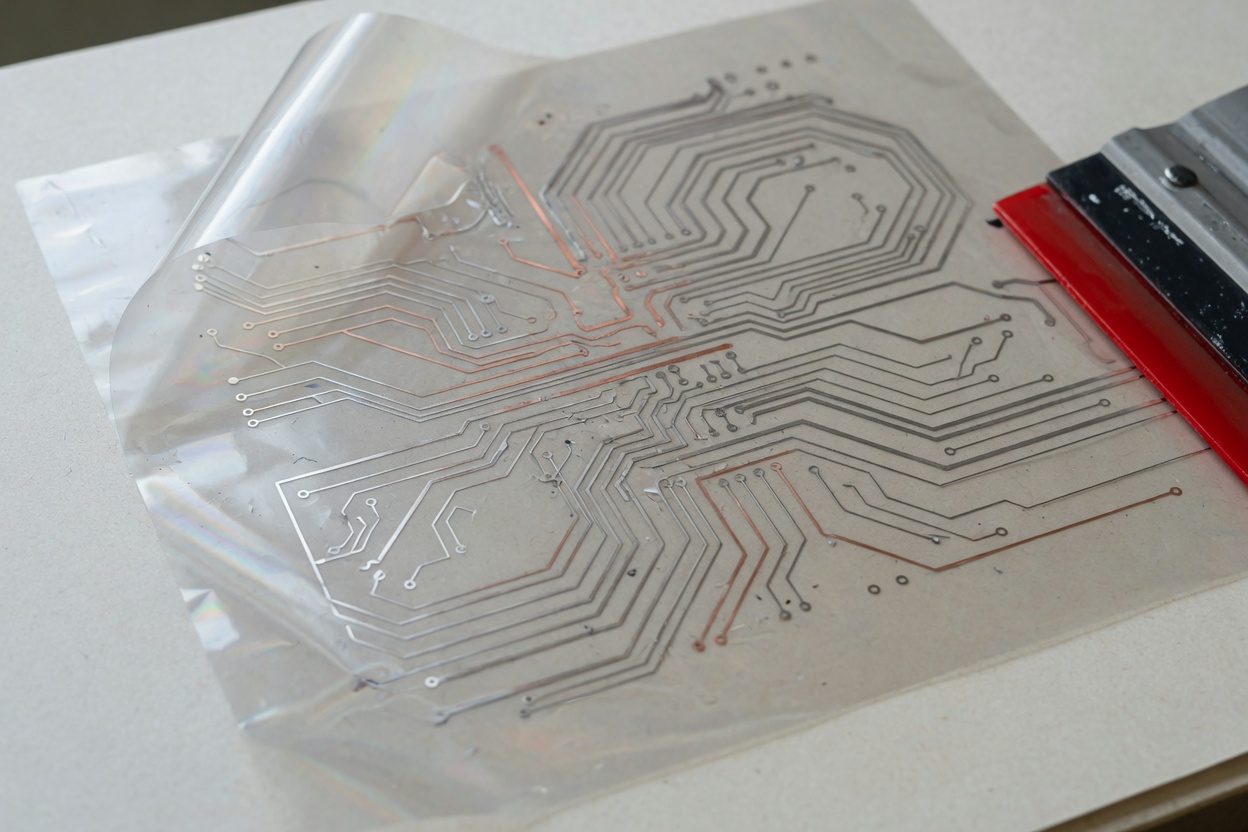
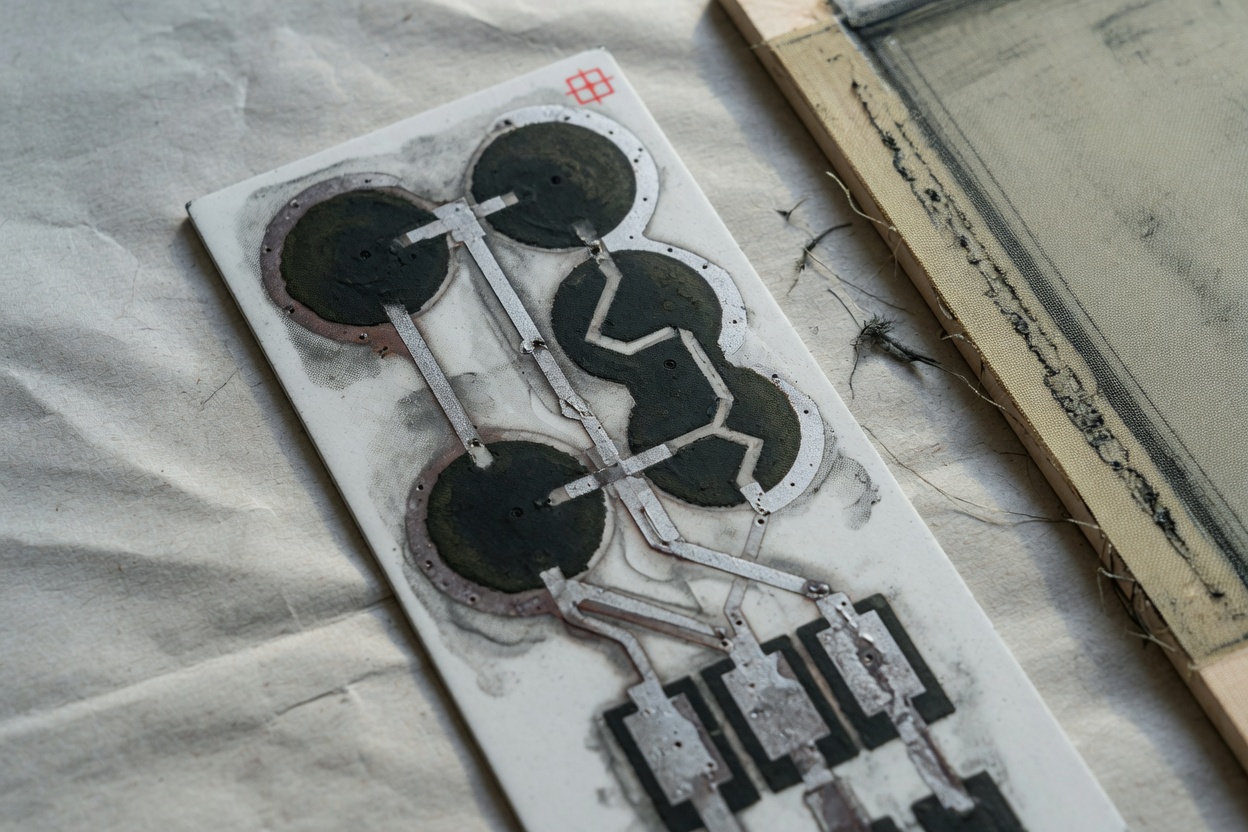
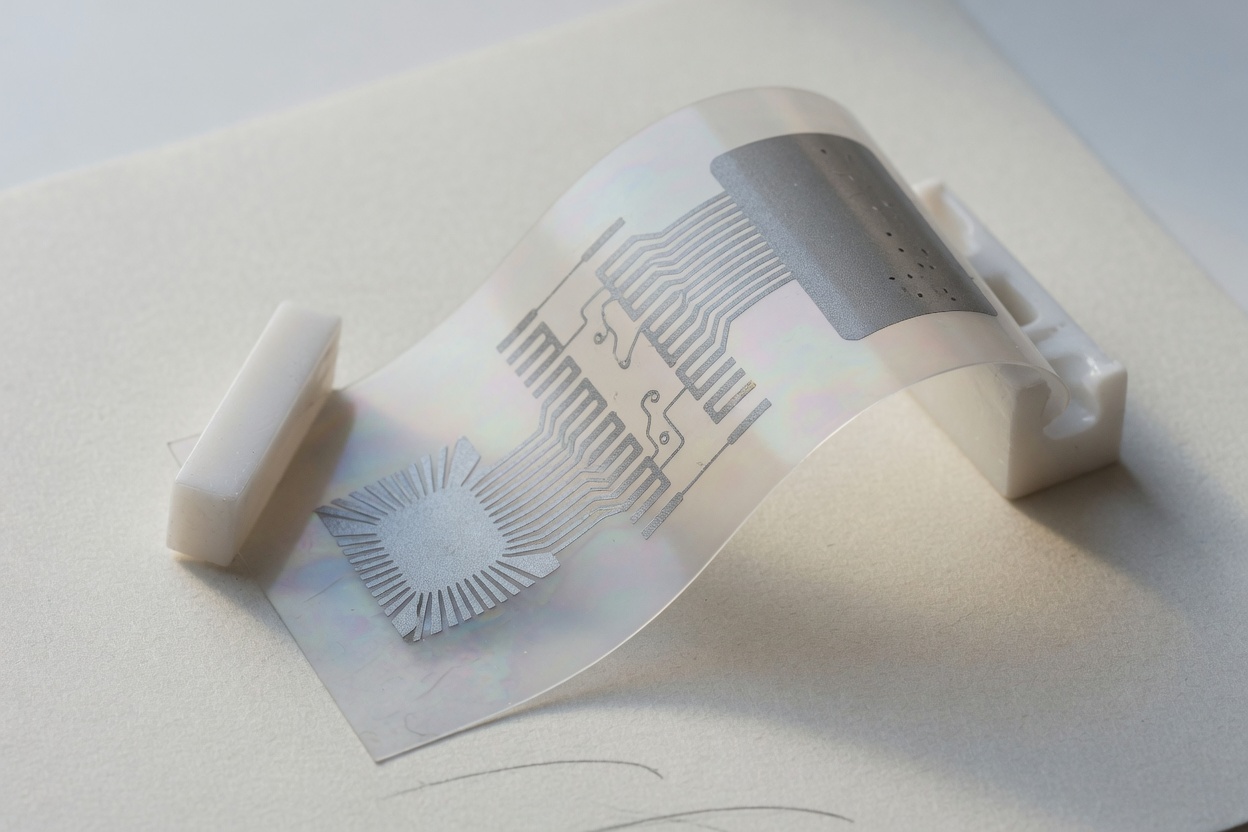
This is where piezoelectric inks meet the rest of printed electronics. A working device is built from a bottom electrode, the piezoelectric layer, a top electrode and, where tracks cross or need protection, a dielectric layer. The electrodes are printed with silver conductive ink; the insulation and crossovers use dielectric inks. The piezoelectric film only performs if the electrodes are conductive, well adhered and correctly registered, and if the dielectric reliably isolates the circuit. In other words, a printed piezoelectric sensor is a system of inks, and its performance depends on how well those inks work together on a given substrate.
Applications: sensing, haptics, harvesting
The application range is broad and growing. As sensors, printed PVDF films detect pressure, touch, impact and vibration, which suits seat occupancy detection, structural and machine health monitoring and flexible touch interfaces. As actuators, they drive localised haptic feedback in thin surfaces and emit or receive ultrasound in flexible transducers, including conformable medical and non-destructive testing probes. As energy harvesters, they convert ambient vibration or body motion into small amounts of electricity to help power autonomous and wearable devices. The common thread is mechanical: anywhere a thin, flexible, conformable film has an advantage over a rigid ceramic block, printed piezoelectric ink has a role.
From material to manufacturable device
Turning a piezoelectric polymer into a reliable printed device is a formulation and integration problem as much as a materials one. The piezoelectric ink has to print cleanly at the right thickness, anneal and pole within the substrate's thermal budget, and stack faithfully with the silver and dielectric inks around it. That is precisely the value of working with a formulator that masters the whole printed stack rather than a single material. VFP Ink Technologies formulates screen printing piezoelectric inks, PIEZO ELECTRON SOLVENT and PIEZO ELECTRON UV, non-CMR and PFAS-free, alongside its silver conductive and dielectric ranges, and supports their integration into complete printed devices. If printed piezoelectric sensors or actuators are on your roadmap, talk to us about your specification.