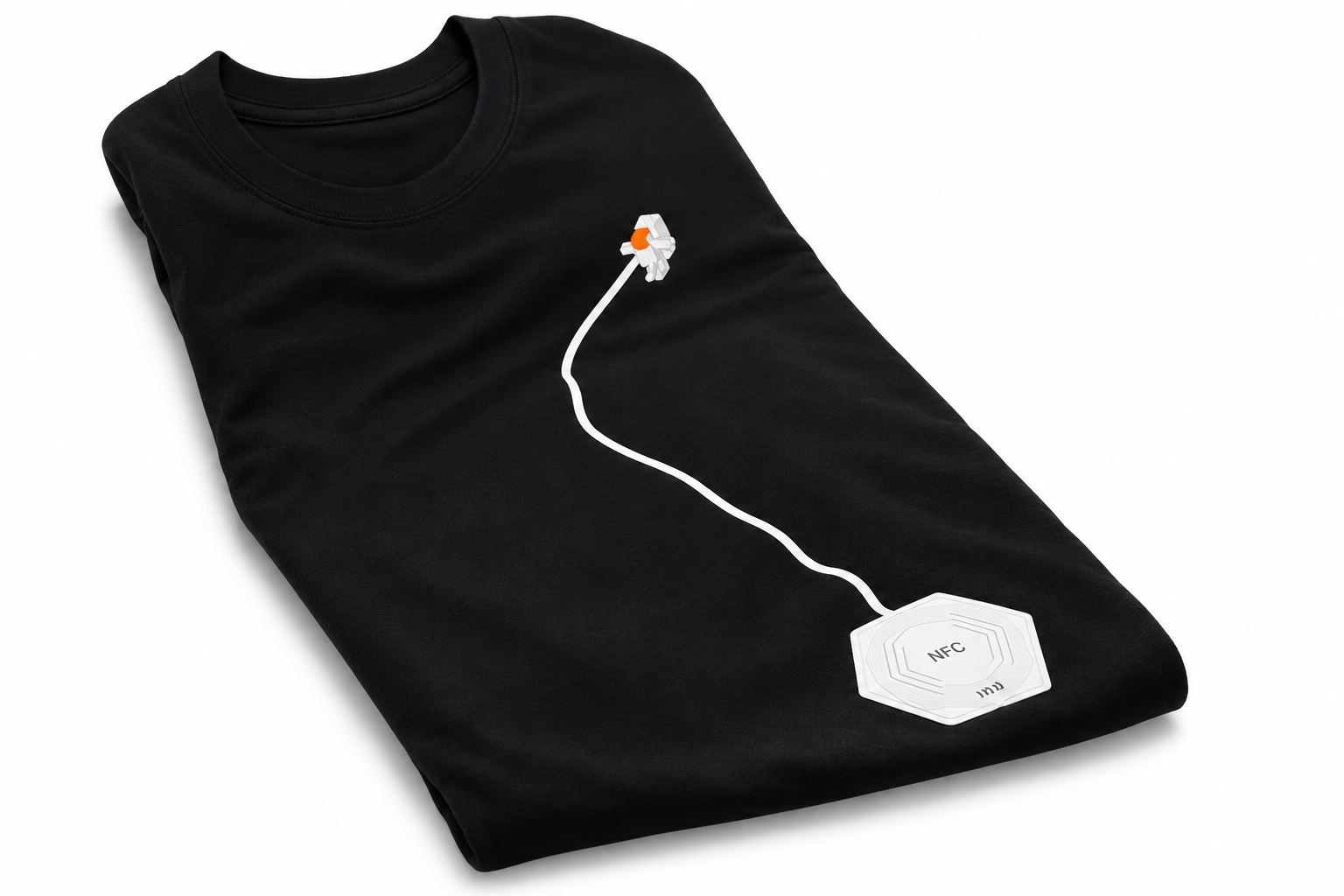
A conductive ink for e-textiles is an ink, usually silver-based, that is screen printed to form tracks, electrodes or antennas on a fabric, or on a soft film that will later be bonded to it. What sets it apart is mechanics: it has to keep conducting while the garment bends, stretches and twists. That is why smart textiles rely on stretchable conductive inks, a distinct family from the silver inks formulated for films that barely deform.
E-textiles: what conductive ink brings to a garment
An e-textile, or smart textile, embeds an electronic function in a garment, a piece of wearable equipment or a soft surface. It is one of the most visible outlets for flexible electronics, and use cases keep expanding: biometric sensors tracking heart rate, breathing or sweat, skin-contact electrodes, heated zones, touch controls built into a sleeve, and interconnects linking an electronic module to sensors spread across the garment. Piezoelectric inks add pressure sensing and energy harvesting to the list. In every case the printed ink replaces added wires and cables: it draws the circuit exactly where it is needed, as a thin layer, without adding stiffness or bulk. The principles behind screen-printed electrodes for biosensors still apply, with one more constraint: the substrate never stops moving.
Why a conductive ink for textiles must be stretchable
A conventional silver ink conducts through contact between its metal particles, held together by a binder. On PET or polyimide film it copes with repeated flexing, but a textile asks for much more: it elongates, compresses, creases and recovers thousands of times over the life of the product. If the binder cannot follow, microcracks open, particles lose contact and track resistance climbs until the circuit breaks. A stretchable conductive ink is formulated to keep its conductive network under strain and to recover it on release. The figure that matters is therefore not only initial resistivity, but resistance measured during and after stretch cycles, on the real build.
Three ways to print a circuit on a textile
Screen printing remains the reference process for e-textiles: it lays down a thick layer in a single pass, which yields low-resistance tracks, and it is already familiar to textile print shops. Three architectures coexist. Direct printing on the fabric, often over an interface layer that smooths the surface and limits ink penetration into the fibres. Printing on a soft film, typically polyurethane, which is then laminated or heat-transferred onto the garment. And printing on a technical film housed in a pocket or module, easier to qualify but less comfortable to wear. The right choice depends on the fabric, the comfort target, the assembly process and the number of wash cycles required.
What to demand from a smart textile ink
A conductive ink for textiles has to meet several requirements at once. High conductivity, to limit losses along long tracks. Resistance to stretching and repeated cycles, measured as the change in resistance. Durable adhesion on the chosen support, whether fabric, interface layer or film. A drying temperature compatible with heat-sensitive materials. Protection of the track: an insulation or encapsulation layer, from the family of dielectric inks and varnishes, insulates the circuit and shields it from abrasion and moisture; on a stretchable substrate it must follow the deformation too, which is qualified in trials. Wash durability, finally, does not depend on the ink alone but on the whole build: fabric, encapsulation, wash cycle and detergent. It is qualified in trials, never taken from a generic promise. And because the circuit is worn close to the skin, chemical safety matters too: an ink not classified as carcinogenic, mutagenic or toxic to reproduction (non-CMR) simplifies regulatory discussions.
SILVER ELECTRON STRETCHABLE: from product sheet to wearable prototype
For these applications, VFP Ink Technologies offers SILVER ELECTRON STRETCHABLE, a stretchable silver conductive ink for printed electronics, presented as a non-CMR solvent-based ink. Its product sheet lists a resistivity below 15 mΩ/sq/mil (3.8×10⁻⁷ Ω·m), a viscosity of 25 poise (Rotothinner, 562 rpm, 25 °C), a coverage of 290 to 370 cm²/g and a screen life of more than 60 minutes. Its listed applications include smart textiles, wearables, In-Mold Electronics (IME) and curved surfaces. Listed substrates are paper and cardboard, PVC, polyurethane, PET, polycarbonate, treated polyester and polyimide: for a given textile, compatibility is checked on the actual build. VFP supports trials and qualification, from choosing the architecture to setting print and drying parameters, through to pairing the ink with insulation and encapsulation layers. If an e-textile project is on your roadmap, talk to us about your specification.
Frequently asked questions
Which conductive ink should be used on a textile?
A stretchable conductive ink, usually silver-based and screen printed, because it has to follow the garment's deformation without losing conductivity. At VFP, SILVER ELECTRON STRETCHABLE is the grade that lists smart textiles among its applications; its fit with your fabric is confirmed in trials.
Can conductive ink be printed directly on fabric?
Yes, depending on the fabric structure, often over an interface layer that evens out the surface. The common alternative is to print on a soft film, then laminate it onto the garment.
Is conductive textile ink washable?
Wash durability depends on the whole build: ink, encapsulation, fabric and wash cycle. It is qualified on your prototype; no generic value can replace that test.
What is the difference between a stretchable and a standard silver ink?
A standard silver ink is designed for flexible films subjected to bending. A stretchable ink is formulated to keep its conductive network under elongation, which is what textiles and wearables require.
Related resources
Explore the ranges: Conductive inks for printed electronics, Silver conductive inks for printed electronic circuits. The SILVER ELECTRON STRETCHABLE product sheet. Printed electronics. Discuss your project.